The planned transaction involving Orangekloud, Orbis, and VeVe has reached a new and much more concrete stage. The definitive agreement was signed on August 21, 2026, and Orangekloud announced the news on August 24, 2026.
This means the non-binding letter of intent announced in February is no longer the latest development. Even so, the most important distinction still applies: A signed agreement does not mean the deal has closed—and VeVe is not yet trading under the ticker VEVE.
TL;DR: Orangekloud is set to acquire Orbis. Following a successful closing, Orbis would become a subsidiary, Orangekloud is expected to be renamed VeVe Inc., and the Class A shares are expected to trade on Nasdaq under VEVE. Before that can happen, financing, shareholder, Nasdaq, regulatory, and other conditions must be met. The signing alone does not change anything for VeVe accounts, Gems, or collectibles.

What Has Changed Since the Letter of Intent
On February 11, 2026, Orangekloud and Orbis initially announced a non-binding letter of intent for the proposed transaction. The definitive agreement was still missing in early March, so it was not yet possible to describe the acquisition as contractually binding or the transaction as completed.
That gap has now been closed. The “Agreement and Plan of Exchange of Securities,” dated August 21, sets out the transaction structure, proposed share exchange, financing, post-closing corporate governance, and numerous conditions and termination rights.
Collectors who want to review the story so far can find the starting point in our article about the February Orangekloud–Orbis letter of intent. Our subsequent update on the definitive agreement that was still outstanding at the time explains the next stage.
What Has Now Been Agreed
Under the agreement, Orangekloud will acquire the issued Orbis equity interests through a share exchange. If the transaction closes successfully, Orbis would become a subsidiary of Orangekloud.
Immediately before closing, Orangekloud is expected to amend its corporate documents and adopt the name VeVe Inc. or another name selected by Orbis. The proposed Nasdaq ticker is VEVE, although the agreement also states that it may be replaced by another ticker selected by Orbis.
The name change and ticker change are therefore part of the planned closing. They do not take effect simply because both parties have signed the agreement.
Planned Leadership After Closing
A seven-member board of directors is planned for the period after closing. Orbis is expected to nominate four candidates, two seats are reserved for existing Orangekloud directors, and another candidate is to be selected by adviser Meyzer.
The board’s composition must meet Nasdaq independence requirements. Senior management positions at the combined company are expected to be filled by individuals selected by Orbis.
What the Up to 600 Million Orangekloud Shares Mean
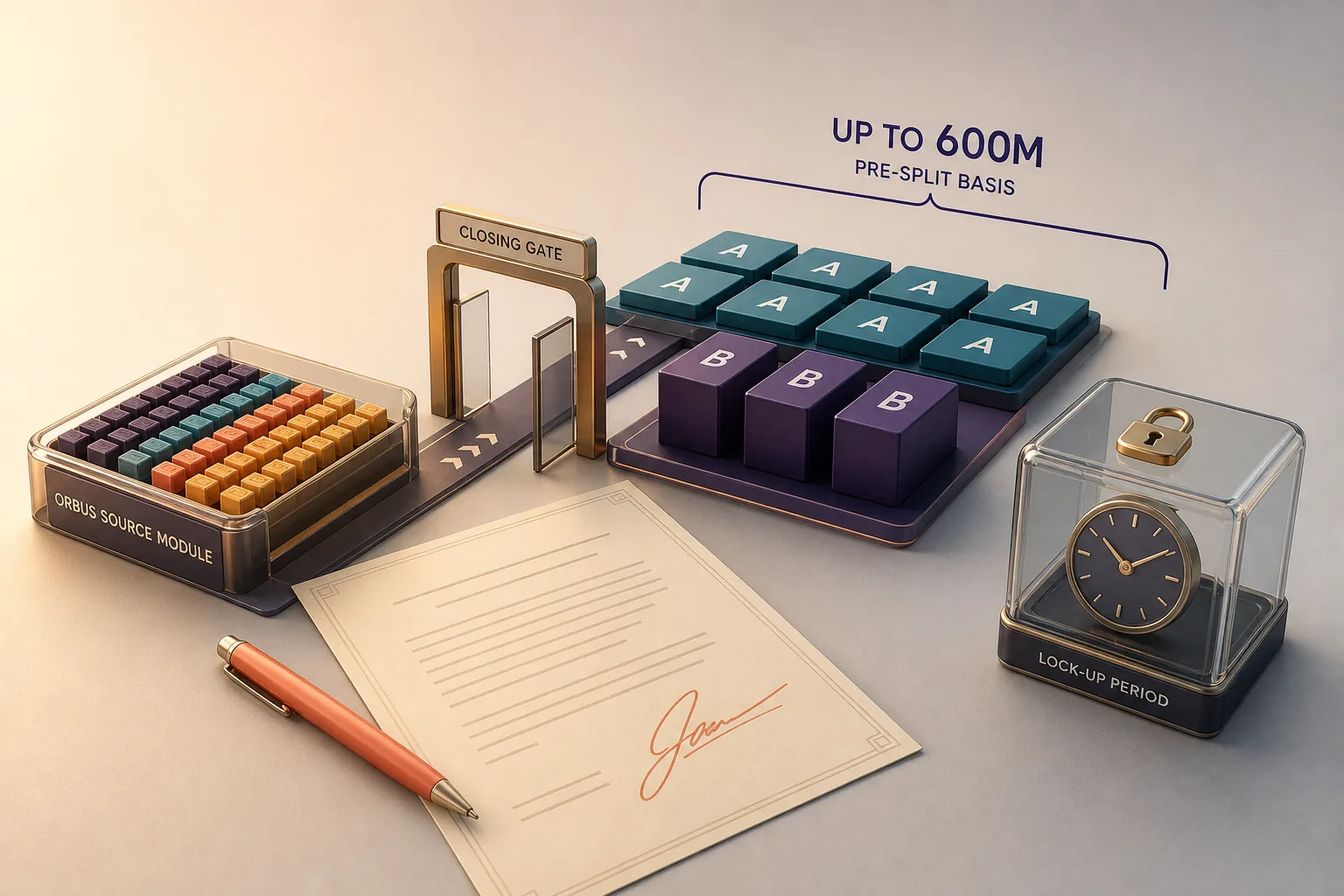
Up to 3,967,705 Orbis equity interests, representing all Orbis interests outstanding immediately before closing, may be exchanged for up to 600 million Orangekloud shares. This cap is stated on a pre-reverse-split basis and may be adjusted through the exercise of certain Orbis warrants.
For each covered Orbis common share, the agreement provides for 37.8048 Orangekloud Class A shares and 113.4144 Class B shares. In total, the agreement lists approximately 150 million Class A shares and just under 450 million Class B shares as potential maximum amounts.
This Does Not Mean 600 Million Freely Tradable Shares
The figure should not be interpreted to mean that 600 million new shares will automatically be sold freely on the stock market on the closing date. It is the maximum consideration for the Orbis interests being contributed, divided between two share classes and dependent on the actual circumstances at closing.
Orbis shareholders have also entered into lock-up agreements covering a period of twelve months after closing, subject to customary exceptions. This limits the immediate transferability of the shares they receive, but it does not eliminate the long-term significance of the substantial share issuance.
Why Collectors Should Put Terms Like Dilution in Context
New shares generally expand the total share base and change ownership percentages. However, it is not possible to reliably calculate how much individual existing holdings would be diluted from the 600 million-share cap alone.
That calculation would also need to account for the final number of shares issued, a potential reverse split, financing, exercised warrants, and other agreed compensation instruments. The agreement’s assigned value of $1 per share is also a transaction calculation and not a guarantee of a future market price.
In addition, approximately 90.9 million adviser warrants with an exercise price of $1 per Class A share are contemplated at closing. Other potential equity instruments include compensation plans, management awards, and performance-based adviser compensation. This makes the final capital structure more complex than the single headline of “600 million shares.”
Why the Transaction Has Not Closed Yet
There is an implementation period between signing and closing. Orbis can only become a subsidiary once the required conditions have been met or waived where permitted and the closing documents have been exchanged.
The agreement lists several mutual and party-specific closing conditions. Some are particularly important because they require external decisions, new financing, or further review.
1. Orangekloud Shareholder Approval
Orangekloud is expected to hold an extraordinary general meeting. The resolutions required for the agreement and transaction must receive the necessary voting majority.
More than 75% of Orbis’ currently outstanding equity has already signed the agreement. Agreed drag-along mechanisms are expected to increase that figure to at least 93%. However, this does not replace the outstanding vote on Orangekloud’s side.
2. Financing of Between $30 Million and $100 Million
A concurrent private placement of Class A shares is planned on or before closing, with targeted gross proceeds of at least $30 million and no more than $100 million. Confirmation of binding financing commitments in the agreed amount is one of the key conditions.
At closing, $3 million of the proceeds is generally expected to go to an operating Orangekloud subsidiary for ongoing operations, subject to adjustments provided for in the agreement. The agreement also permits separate operating-expense financing of up to $6 million within certain limits.
3. Nasdaq Approval and Continued Listing
The Class A shares contemplated as part of the transaction, financing, and warrants must be approved for Nasdaq listing. Orangekloud has agreed to use reasonable efforts to obtain that approval and commercially reasonable efforts to maintain the listing.
The exact wording matters: The agreement does not create an automatic right to listing approval. The continued Nasdaq listing of Orangekloud’s existing Class A shares is also one of the conditions benefiting Orbis.
4. Regulatory Clearance in New Zealand
If required, consent or a statement of no objection from the New Zealand Overseas Investment Office must be obtained. Under the agreement, Orangekloud is responsible for any required application as an overseas person.
The signing alone does not reveal whether the authority will impose conditions or what form they might take. A later official regulatory notice or closing confirmation will be the relevant evidence.
5. Reviews, Fairness Opinion, and Other Documents
The conditions also include the completion of financial, tax, and legal due diligence without material adverse findings, as well as final approval by Orangekloud’s board after it receives a satisfactory independent fairness opinion.
Additional requirements include accurate representations from the parties, compliance with their obligations, required lock-up and voting documents, a Nasdaq-compliant governance structure, and agreement on the form of the adviser warrants.
New to VeVe and want to understand platform features, Gems, and registration separately from stock market news? Our VeVe sign-up and starter credit guide explains how to get started. Eligible new users may receive a free $10 starter credit; be sure to review the applicable promotion terms first.
The December 31, 2026 Long-Stop Date
Orangekloud or Orbis may generally terminate the agreement if closing has not occurred by December 31, 2026. An extension is provided for certain circumstances related to SEC regulations.
The long-stop date is not a promised closing date. Instead, it is a contractual deadline after which a termination right may arise, provided the terminating party’s own breach was not the primary cause of the delay.
Even if the date passes, the transaction would not automatically end at that exact moment. The specific contractual circumstances, a potential extension, and a formal termination or amendment notice would determine what happens next.
What Does This Mean for VeVe Collectors Today?
The stock market and corporate structure are relevant to collectors, but they should not be confused with the operating rules of the VeVe app. Signing the agreement does not automatically change an account’s status, Gem balance, or holdings of digital collectibles and comics.
The signing also does not automatically introduce a new transfer feature, cash-out option, KYC rule, Market Fee, or OMI utility. Such product changes should only be treated as confirmed if VeVe or Orbis publishes them through official product information, updated terms, or specific in-app notices.
Collector Checklist for the Current Situation
- Keep using your account normally: No automatic user action has been announced solely because of the agreement.
- Do not complete any supposed share or token migration: The share exchange concerns the participating companies and shareholders, not VeVe collectibles held in user accounts.
- Do not accept DMs offering “Nasdaq verification”: A corporate acquisition does not require you to provide a password, 2FA code, recovery information, or wallet keys.
- Review product rules separately: Gems, fees, KYC, OMI, and CollectChain remain separate topics, each with its own official rules.
- Wait for specific documents: Relevant items include voting materials, financing evidence, Nasdaq notices, regulatory decisions, and the formal closing announcement.

What to Watch Before Closing
The next reliable signals will likely come from corporate and stock exchange filings rather than social media speculation. Collectors can track the process through a few clear milestones.
Shareholder Vote
The notice of the extraordinary general meeting, proposed resolutions, and published voting results will be key. Announcing a meeting date does not constitute approval; only the result will show whether the required majority was reached.
Financing
Watch for binding commitments for the private placement and the final terms that are disclosed. The broad range of $30 million to $100 million does not indicate how much will actually be raised.
SEC and Nasdaq Filings
New SEC filings may contain supplements, voting documents, agreement amendments, or further details about the capital structure. For the proposed VEVE ticker, it will also be crucial to see whether the required Nasdaq approval is granted and the change is officially announced.
New Zealand Approval
If clearance or a statement of no objection from the Overseas Investment Office is required, it should be explicitly documented. Until then, this condition should be treated as outstanding.
Closing Announcement
The clearest confirmation would be an official announcement that the transaction has closed. Only then would statements such as “Orbis is a subsidiary,” “Orangekloud has been renamed VeVe Inc.,” or “the ticker change is effective” be factually supportable.
Avoid These Common Misinterpretations
- “Definitive agreement” does not mean “deal completed”: The agreement is binding, but closing remains subject to conditions.
- “VEVE planned” does not mean “VEVE is already trading”: The name and ticker are intended to take effect at closing.
- “Up to 600 million shares” does not mean “600 million shares have already been issued”: This is a cap within the agreed exchange.
- “$1 per share” is not a price target: The figure is an assigned transaction value, not a stock market forecast.
- A stock market deal is not an app update: Changes involving Gems, collectibles, OMI, KYC, or fees require their own official confirmation.
FAQ About the Orangekloud–Orbis Agreement
Is VeVe Now Listed on Nasdaq?
No, not as a renamed company under the ticker VEVE. Orangekloud is the existing publicly traded company; the VeVe Inc. name and VEVE ticker are planned for the successful closing of the transaction.
Has the Merger Already Closed?
No. A definitive share exchange agreement was signed on August 21, 2026, and publicly announced on August 24. Closing is still pending.
Do VeVe Users Need to Confirm Anything in Their Accounts?
Not based on the agreement announcement. Users should not open links in direct messages or complete any supposed acquisition, Nasdaq, or migration verification.
Will Gems or Collectibles Be Converted Into Shares?
No. The agreement describes an exchange of corporate equity interests between Orbis shareholders and Orangekloud. VeVe Gems and digital collectibles are not Orangekloud shares.
Is Closing Guaranteed for December 31, 2026?
No. That date is the contractual long-stop date, not a guaranteed closing date. The transaction may close earlier, be extended under certain circumstances, or be terminated if conditions are not met.
Are Any Effects on OMI or CollectChain Confirmed?
The Exchange Agreement does not automatically change these systems. Any specific effects should only be treated as confirmed following an explicit official product or company announcement.
Conclusion: An Important Milestone, but Not the Finish Line
The definitive agreement is the clearest progress yet in the Orangekloud–Orbis process. It replaces the non-binding LOI with a detailed agreement and sets out how Orbis is expected to be acquired, Orangekloud renamed, and the proposed Nasdaq ticker VEVE introduced.
However, several substantial steps remain before closing. Shareholder approval, financing, Nasdaq approval, reviews, and potential New Zealand clearance are not formalities that collectors should assume have already been completed.
For VeVe users, the measured takeaway is this: There is a new binding development at the corporate level. For everyday collecting, the officially communicated product features and rules remain unchanged for now.
If you want to try VeVe independently of the stock market process, you can register through Sign up for VeVe with a $10 starter credit and receive a free $10 starter credit with an eligible registration. Disclosure: VeVeInsider may receive an affiliate commission; there is no additional cost to you, and you receive a free $10 starter credit.
Sources
- Agreement and Plan of Exchange of Securities dated August 21, 2026
- Orangekloud Technology Inc.—Form 6-K dated August 24, 2026
- Orangekloud Technology Inc. Enters into Definitive Agreement to Acquire Orbis Technology Limited
- Orangekloud Acquires VeVe Operator and Will Become VeVe Inc.
- Orangekloud to Rebrand as VeVe Inc. in Deal to Acquire Orbis and Digital Collectibles Platform