If you hold or trade crypto or collect NFTs, 2026 is an important date in the EU because of DAC8. It represents another expansion of EU-wide tax transparency—this time focusing on crypto-assets and, indirectly, many NFT use cases, depending on how you buy and sell them.
First, an important note: This is not legal or tax advice. It is a collector-first overview of what could change at a high level, plus a practical documentation routine that can help you regardless of DAC8.
TL;DR
Starting in 2026, crypto-asset service providers in the EU—such as exchanges and brokers, depending on the definition—are expected to report more customer data and information about certain crypto transactions to national authorities. This information may be exchanged across the EU. For users, the main takeaway is that keeping your own accurate records will become more important. Record the date and time, transaction type, value, fees, and relevant IDs or hashes so you can clearly explain incoming and outgoing transactions later.
What Is DAC8, and Why Is Everyone Talking About It?
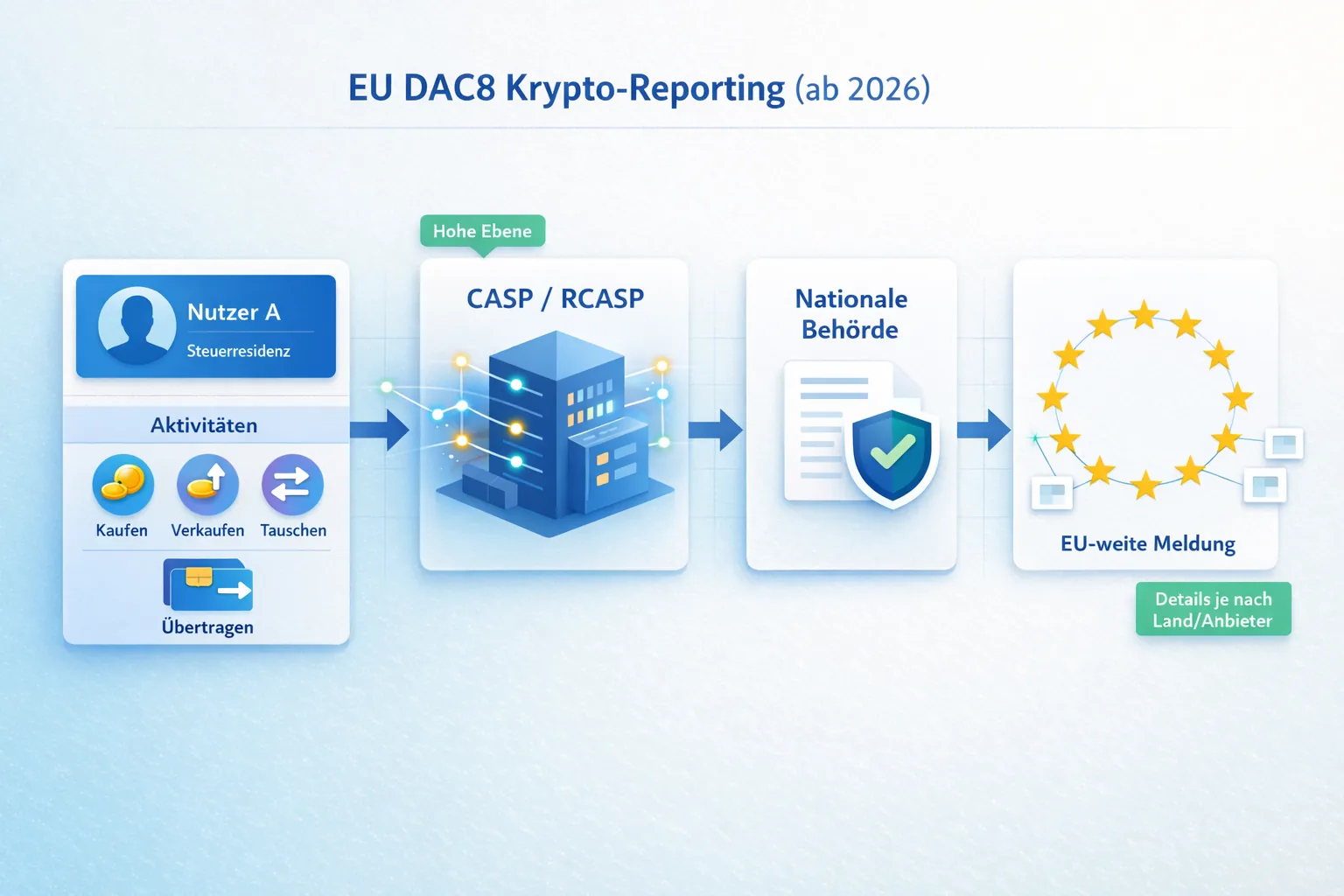
DAC8 is an EU framework for administrative cooperation between tax authorities. In short, EU member states are expected to exchange potentially tax-relevant information in a more structured way, with certain platforms and service providers required to submit standardized reports.
The key change under DAC8 is that crypto-assets are explicitly incorporated into this framework. It is less about “banning crypto” and more about reducing blind spots when users trade through providers that already collect identity information through Know Your Customer (KYC) processes.
What Could Be Reported Under DAC8? A High-Level Overview
The exact level of detail may vary depending on national implementation, definitions, and each provider’s setup. At a high level, reporting generally falls into two categories: who you are—identification and tax residence—and what you did—certain transactions and asset movements.
Who Reports?
The focus is on Crypto-Asset Service Providers. In practice, these often include:
- Exchanges for buying, selling, and swapping.
- Brokers or providers that execute trades “for you.”
- Custody providers that hold assets on your behalf.
- Depending on the model and definition, potentially other intermediaries that facilitate or process transactions.
Importantly, self-custody—where you hold the keys yourself—is not a “service provider.” However, as soon as you deposit or withdraw, such as to or from an exchange, you create another touchpoint where data may be collected.
What Identity Information Could Typically Be Collected or Transmitted?
- Personal or business information, such as your name, address, and potentially your date of birth.
- Tax residence and potentially a tax identification number or similar identifier, depending on the country and process.
- Account information held by the provider, such as an account or user ID.
This is consistent with the information many platforms already request through KYC processes, even though DAC8 is not specific to VeVe.
What Activities Could Typically Be Reportable?
At a high level, reporting often concerns transactions in which value is exchanged or moved—activities that may have tax implications in many countries:
- Crypto to fiat, such as selling for EUR.
- Fiat to crypto, such as buying with EUR.
- Crypto to crypto, such as a swap or trade between two assets.
- Transfers, including deposits and withdrawals involving external wallets, depending on the standard and its implementation.
- Certain NFT-related activities when processed through a reporting service provider, such as a purchase or sale on a marketplace that qualifies as a service provider, or a payment made through an exchange or on-ramp.
For collectors, the key question is often not “Are they reporting my favorite NFT?” but rather: Do I have a complete record showing how money or crypto moved in and out, and how a gain or loss occurred?
What Transaction Values or Information Could Appear?
Without promising specific details, the following information is typically relevant:
- Date and time of the transaction.
- Transaction type, such as a purchase, sale, swap, or transfer.
- Asset and amount, such as BTC or ETH; for NFTs, this could include a unique token ID or collection and token ID where available.
- Value received or exchanged, such as an amount in EUR or another asset.
- Fees, including trading fees and network fees or gas, where recorded by the system.
This is exactly why your own tracking is so valuable: provider data is often “gross,” while your real result is usually “net” after fees, extra steps, multiple wallets, and multiple marketplaces.
Why Users May Need Better Documentation Going Forward
Many collectors realize too late that a transaction history is not a diary. It is more like a stream of raw data—and raw data without context can quickly become misleading.
Why Records Become Confusing Without Your Own Documentation
- Multiple platforms: You buy on Exchange A, transfer to a wallet, purchase an NFT on Marketplace B, then later sell it and transfer the funds back.
- Fees everywhere: Trading fees, network fees, marketplace fees, and potentially spreads or slippage do not always appear in one clean overview. If you want a better understanding of fees in the VeVe ecosystem, see VeVe Fees & Costs.
- Cost basis: Without a purchase receipt, CSV, or note, it may later be unclear which acquisition corresponds to which sale, especially with partial sales.
- Changing wallets: Devices break, wallets change, and new addresses are created. Without clear notes, it becomes difficult to identify transfers between your own wallets.
- NFTs: An NFT is not simply “ETH out, JPG in.” You need identifiers such as the collection, token ID, and potentially a marketplace order ID so you can later explain which item was involved.
Quick Start: How to Track Your Crypto and NFT Activity
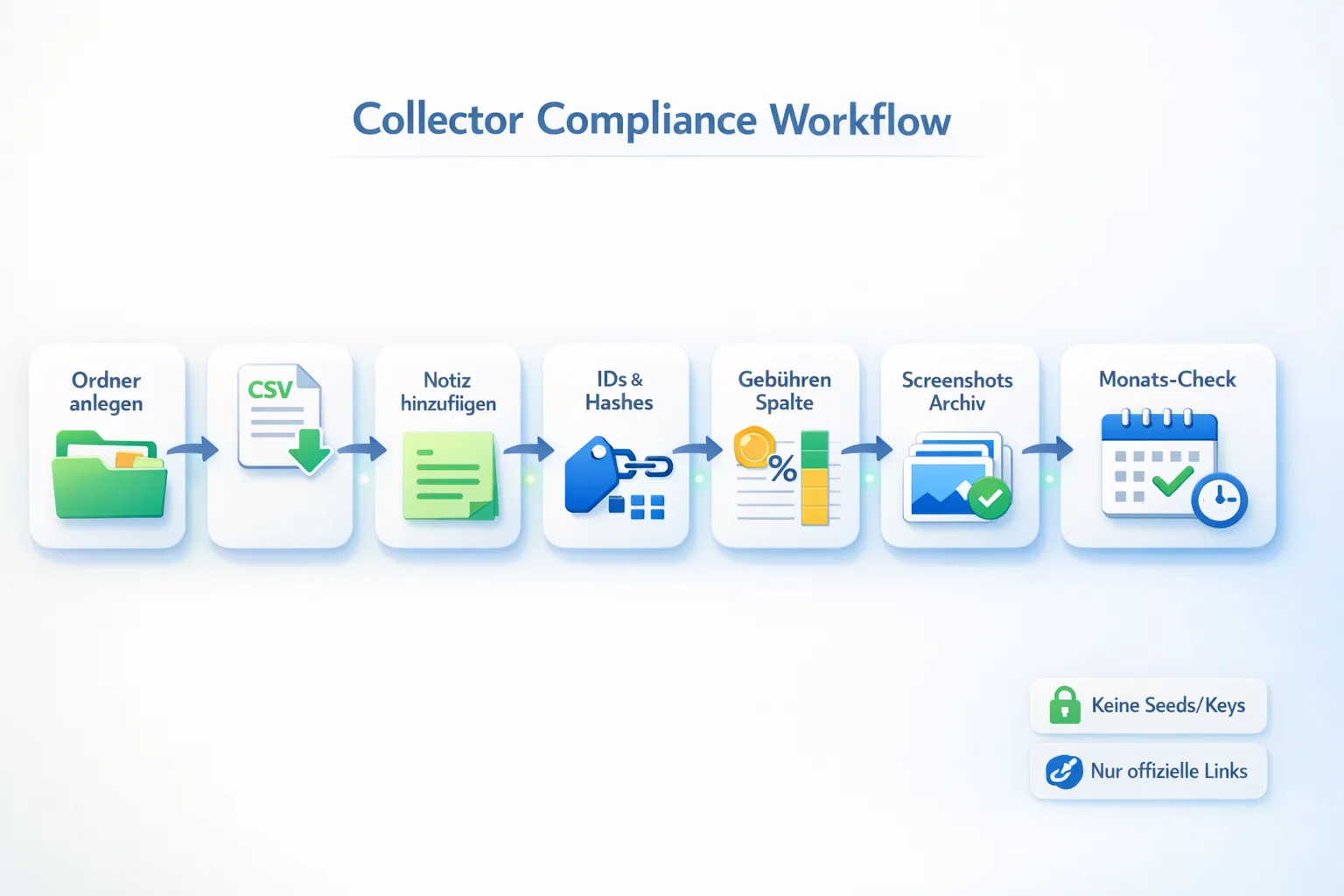
The following routine is intentionally practical. It works for crypto, NFTs, and app ecosystems alike—and it remains useful even if you are not currently subject to tax in the EU or the implementation details change.
Step-by-Step Routine
- Separate your “roles”: If possible, use separate wallets or accounts for collecting, trading, and utility or payments. Less mixing means less to explain later.
- Create an annual folder: For example, use “Crypto-NFT Log 2026” with subfolders for exchanges, wallets, NFTs, receipts, and notes.
- Export CSV files regularly: Exchanges and marketplaces often provide export tools. Do not wait until a provider changes its interface or limits historical data.
- Add context to each purchase or sale: Note why you bought it, which Drop it came from, whether it was a swap or fiat purchase, and whether your goal was to hold, flip, or complete the set. One or two sentences are enough.
- Record identifiers: Include your wallet address, transaction hash, marketplace order ID, and NFT token ID, serial, or edition, depending on the system.
- Track fees separately: A simple “Fees—estimated/confirmed” column can be extremely helpful later, especially when a transaction involves multiple steps.
- Use a screenshot routine: For important events such as larger purchases or sales, withdrawals, or unusual transfers, save screenshots of both the confirmation and detailed view.
- Run a mini-audit at the end of each month: Spend 10 minutes checking whether incoming and outgoing transactions match, whether a transfer is missing, and whether any notes remain incomplete.
If you also use on-chain platforms, a block explorer can help you look up transactions objectively. For Collect Chain and explorer topics in the VeVe ecosystem, this is a useful starting point: Collect Block Explorer Guide.
Collector Checklist: What You Should Keep on File at a Minimum
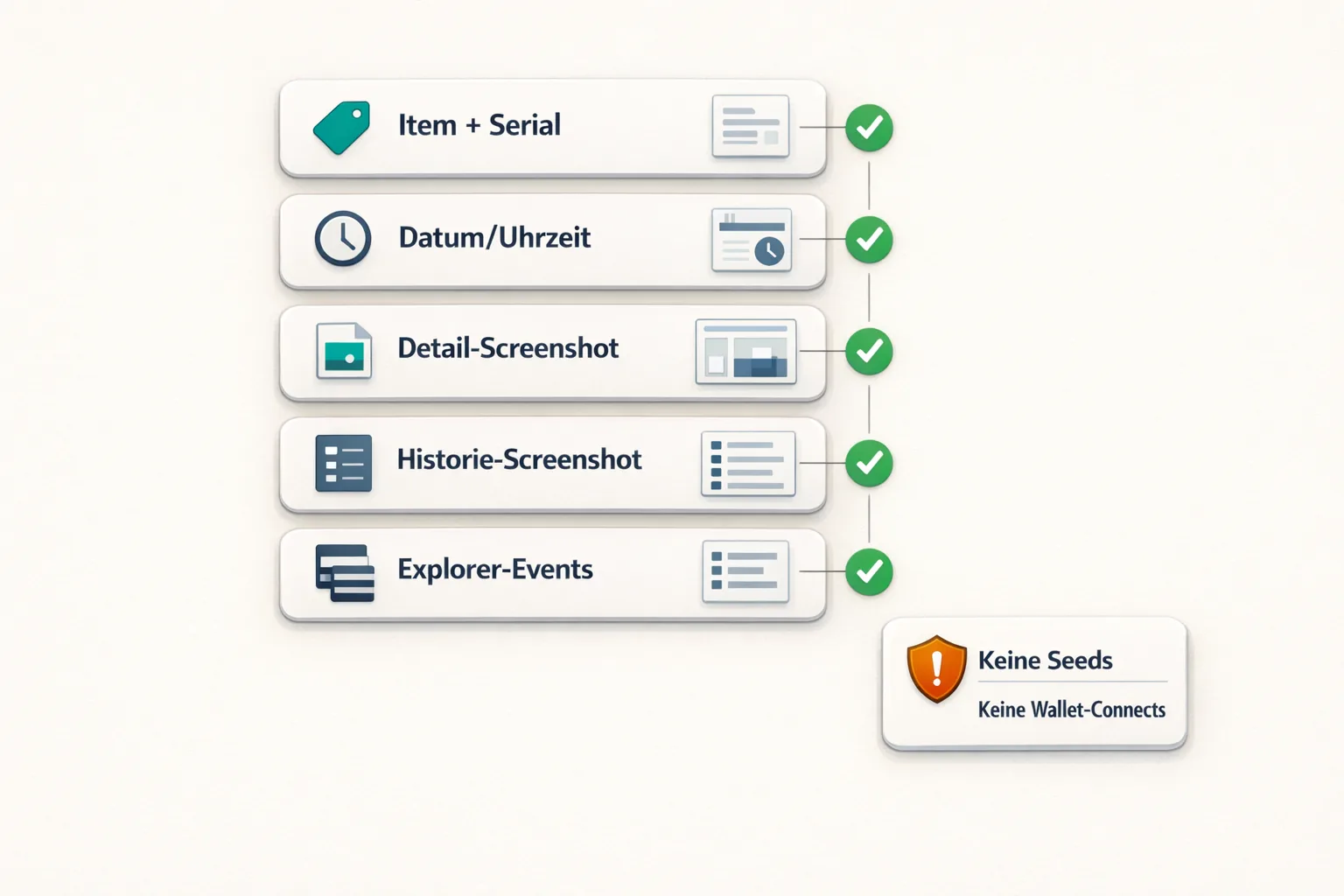
- Exchange reports, including trades, deposits, and withdrawals, in CSV or PDF format.
- Wallet list with your addresses and a short description of each wallet’s purpose.
- NFT list with the collection, token ID or serial, purchase date, purchase method, and sale date.
- On-ramp and off-ramp receipts, such as bank or provider receipts and confirmation emails.
- Fee notes covering trading fees, gas, and marketplace fees, documented as accurately as possible.
- KYC status and important account changes, such as a new email address, new verification, or new devices.
- Special cases, including airdrops, rewards, refunds, and chargebacks, with a brief explanation and screenshot.
Key Terms Explained
- DAC: The EU framework for administrative cooperation and information exchange between tax authorities.
- DAC8: An expansion of the DAC framework that extends reporting requirements for crypto-assets, with application beginning in 2026.
- CASP (Crypto-Asset Service Provider): A provider offering crypto services, such as trading or custody, depending on the applicable definition and regulation.
- Tax residence: The country where you are considered a tax resident, which is not necessarily the same as your nationality.
- Cost basis: Your entry price, including relevant costs, which is important for correctly calculating a gain or loss.
- Transaction hash: A unique identifier for a blockchain transaction—similar to an on-chain tracking number.
- Custody vs. self-custody: Does a provider hold your assets for you, or do you hold the keys yourself? For more context, see Custody vs. Self-Custody.
VeVe-Specific: What Does This Mean for Collectors Using the App?
For many collectors, VeVe is a curated entry point into digital collectibles. At the same time, many users operate in two worlds:
- In-app: Drops, the Market, in-app currency and receipts, and potentially KYC.
- Outside the app: Exchanges, wallets, on-chain marketplaces, or crypto on-ramps and off-ramps.
DAC8 is primarily an EU reporting framework for crypto-asset service providers. Even so, VeVe collectors can benefit from documenting their activity in a way that clearly explains the flow of their funds, including when part of a collection exists within an app environment.
Practical VeVe Records That Actually Help Collectors
- Store purchases and Market trades: Record the date, item, edition or serial, purchase or sale price, and a screenshot of the confirmation.
- Think in net terms: If you trade, make a rough note of the relevant fees and deductions. The VeVe Market Guide can also help with the calculations.
- KYC events: When you complete or update KYC, save a note showing when it happened and what changed. See the VeVe KYC Guide 2026.
- Receipt folder: Save anything labeled “Receipt,” “Invoice,” or “Confirmation” in one central location.
One more point that is often underestimated: Start with good records from day one. Building a routine early means less catching up later. If you are new, these basics are often more useful than any rumor: the VeVeInsider Blog overview and the common pitfalls covered in VeVe Beginner Mistakes & Fixes.
New to VeVe? According to the current starter credit guide, if you sign up through our link at no additional cost to you, you will receive a 10 $ starter credit.
Avoid These Common Mistakes So DAC8 Does Not Catch You Off Guard
- “I’ll track it later”: By then, CSV files, screenshots, or context may be missing. Export your records at least once a month.
- Mixing wallets and accounts: If collecting, trading, and utility activity all happen in one wallet, everything becomes harder to explain.
- Saving only gross values: Fees, gas, and marketplace deductions can quickly make gross figures difficult to compare.
- Recording NFTs without identifiers: “A Spider-Man NFT” is not enough. You need the collection and token ID or serial, depending on the system.
- Not marking transfers between your own wallets: A transfer from Wallet A to Wallet B can look like an outflow unless you note that both wallets belong to you.
- No backups: Losing a device creates unnecessary stress. At a minimum, have a secure password and recovery strategy—and never store seed phrases in cloud screenshots.
- Using unofficial links for compliance topics: For reporting, KYC, and wallet matters, use only official provider websites. Never share seed phrases or connect a wallet through direct messages.
FAQ
As an NFT Collector, Do I Now Have to Report Everything Automatically?
Not automatically—and certainly not as a blanket rule. DAC8 focuses on reporting by service providers, such as exchanges and brokers. Your most important step is maintaining your own documentation so you can clearly explain incoming and outgoing transactions. For specific obligations, consult a tax professional or the rules in your country.
Does This Apply if I Only Use Self-Custody?
Self-custody is not a service provider. However, as soon as you interact with a service provider, such as a fiat on-ramp, exchange, or custody service, new data points are created. Self-custody records are also helpful because otherwise you are effectively your own support team when reconstructing your history.
What if I Trade on Multiple Platforms?
In that case, a master log—one central list—is useful. Add one row per event with the date, platform, asset, amount, value exchanged, fees, and a link, hash, or screenshot path. This can drastically reduce the amount of information you need to piece together later.
Can I Rely Only on an Exchange’s Annual Statements?
They can be a starting point, but relying on them as your only source is risky. Statements often are not designed to show your full path across multiple wallets and marketplaces, including fees. Save CSV files and add your own context.
What Is the Biggest Collector-First Tip for 2026?
Build a routine you can complete in 10 minutes per month. Do not aim for perfection—be consistent. The effect adds up: after 12 months, you will have an organized archive instead of 12 months of chaos.
Conclusion: No Need to Panic, but a Good Reason to Build Better Collector Habits
DAC8 is another step toward standardized transparency in the crypto sector beginning in 2026. For collectors, this is not a reason to rush or panic. It is a reminder that anyone collecting digitally should treat digital records like real records.
Once again: This is not legal or tax advice. If you are unsure how specific transactions are treated for tax purposes in your country, seek professional guidance and use your documentation as a solid foundation.
New to VeVe? According to the current starter credit guide, if you sign up with our affiliate link at no additional cost to you, you will receive a 10 $ starter credit.
Sign Up for VeVe With Starter Credit
Note: Affiliate link—we may receive a commission at no additional cost to you.
Selected official sources:
- European Commission—DAC8 overview
- OECD—Crypto-Asset Reporting Framework (CARF) background and guidance