If VeVe suddenly shows you a Restricted Access notice—or your account ends up disabled—the biggest issue is usually uncertainty. Are your collectibles gone? Is it only temporary? Is one ticket enough? Or are you now facing KYC, a review, and a long wait?
The short answer: Not every restriction means the same thing. Restricted often means certain features are blocked, while disabled is significantly more serious and severely limits what you can do within the ecosystem. The important thing is not to panic, but to document the situation carefully and take a structured approach.
TL;DR: If your VeVe account is restricted, immediately save screenshots and note the date, time, device, and error message. Submit one clear support ticket and prepare your KYC documents. Restricted usually means your account still exists, but key features are blocked. Disabled is the more serious status. During this process, avoid DMs, off-app deals, paid “helpers,” and any form of automation.

Restricted vs. disabled: The key difference
Restricted Access
With Restricted Access, your account is often still visible, and your collectibles may continue to appear in it. However, the features that make VeVe usable may be blocked, including the Market, Feed, purchases, sales, or other interactions.
This matters because many users initially think, “My collectibles are still there, so it can’t be that bad.” But a restriction is still a serious issue for everyday VeVe use because you cannot trade freely or respond to changing Market conditions.
Account disabled
Account disabled is generally viewed as the more serious escalation. This is not simply one blocked feature—it is a status in which VeVe limits or stops your overall access more extensively.
From a collector-first perspective, you should not treat a disabled account like a minor app glitch. In this situation, you need a clear recovery strategy, not rushed improvisation.
What VeVe officially makes clear
Several fundamentals can be drawn fairly clearly from VeVe’s public communications. In its KYC article, VeVe explains that identity verification may be required to access all features. It also states that users who have not successfully completed verification may still be able to view their collectibles but cannot fully use key features such as the Store, Market, or Payout.
The framework became stricter on November 19, 2025, when VeVe announced and implemented new Terms of Use and new Terms for Gems. Gems were reclassified as a licensed, non-transferable and non-redeemable in-app product. VeVe also began acting as a behind-the-scenes intermediary in the secondary market. For a detailed look at these changes, read our guide to the VeVe Gems Terms from November 2025 and our breakdown of Payout after November 19, 2025.
Another important point: VeVe’s official rules and promotional terms use the concept of a valid account. For certain purposes, an account may only be considered valid if it is neither restricted nor disabled and is not under investigation for possible violations. This is not a minor detail—it is a clear signal that account status is a genuine compliance factor.
What you should do immediately
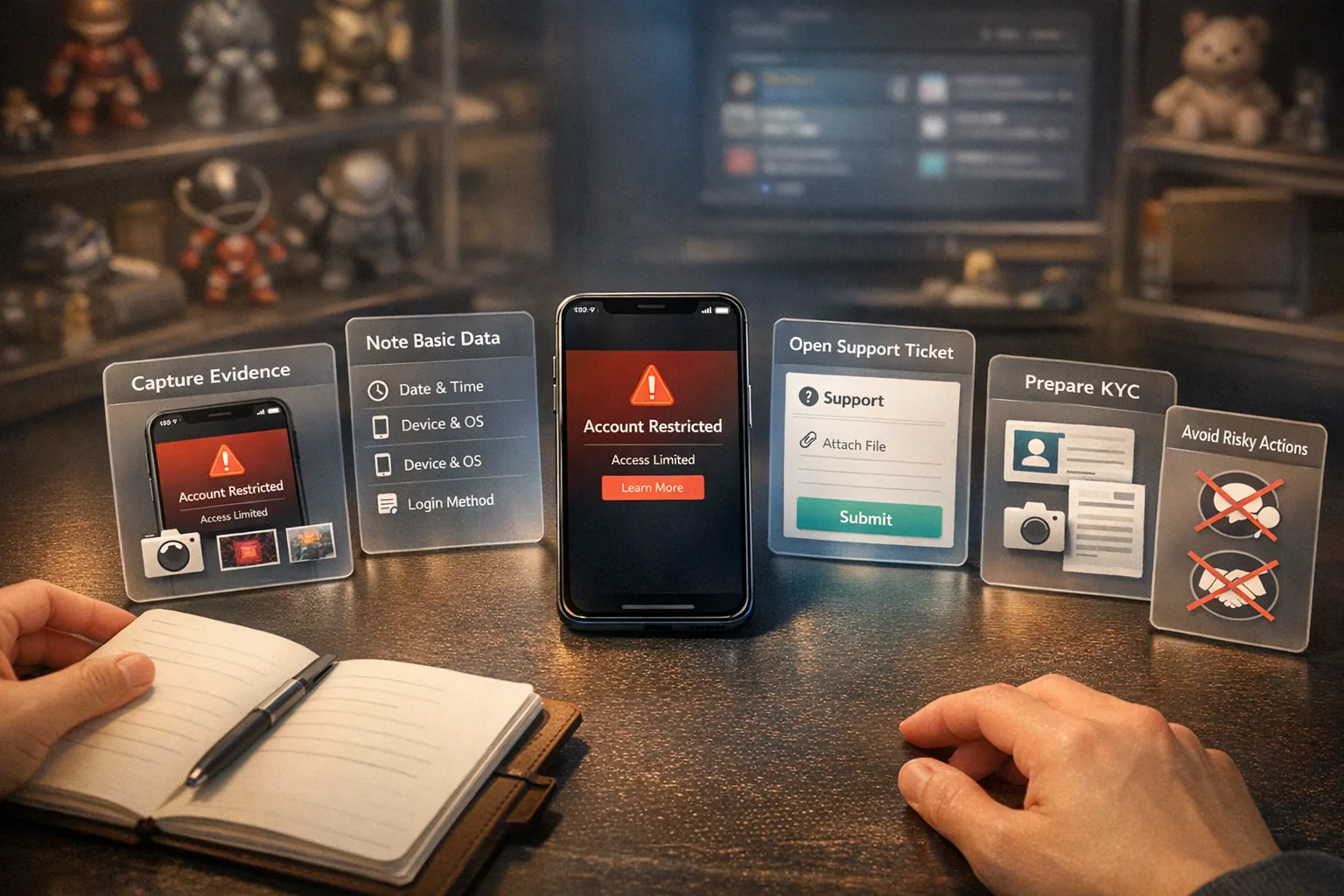
- Step 1: Immediately take screenshots of every error message. This includes the login screen, Restricted notice, disabled message, Market restriction, missing buttons, and any unusual KYC prompts.
- Step 2: Record the basic details. The date, time, time zone, app version, operating system, device, login method, and what you did immediately before the restriction can be extremely helpful later.
- Step 3: Document the current state of your account. Take screenshots of your visible collectibles, active listings, auctions, wallet view, and relevant emails.
- Step 4: Open exactly one clear support ticket. Do not submit five parallel tickets with different versions of the story. That often slows reviews down rather than speeding them up.
- Step 5: Prepare for KYC even if it has not yet been requested. Have your ID, a device suitable for taking a selfie, and a current proof of address ready. Our VeVe KYC guide covers the most common pitfalls.
- Step 6: Do not make unnecessary changes right now. Avoid switching devices in a panic, starting new off-app trades, logging in through suspicious links, or experimenting with emulators or automation.
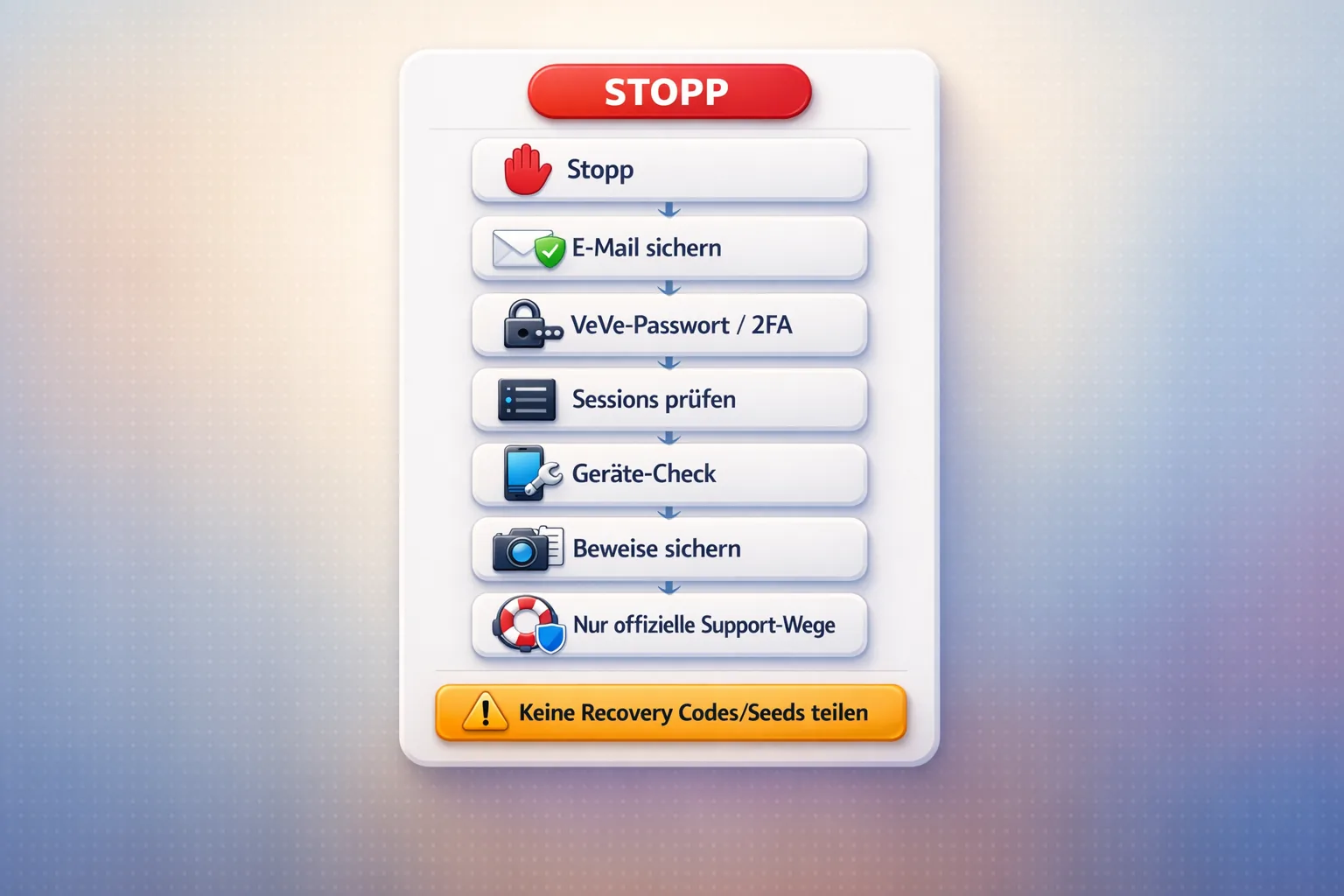
A good support ticket is short, factual, and complete. Do not write a novel, vent your anger, or make accusations. Clearly explain what happened, when the restriction began, and that you would like your account reviewed.
Example of a clear ticket:
Hello VeVe Support, my account has shown a Restricted or disabled status since April 15, 2026. I use device X with operating system Y and log in through Z. The message appeared after the following action: … I have attached screenshots. Please review my account and let me know whether KYC or any additional information is required. Thank you.
New to VeVe? If you sign up through our link at no additional cost to you, the current sign-up credit guide says you will receive a $10 sign-up credit.
When KYC comes into play and how to prepare
KYC on VeVe is not only a Payout issue. VeVe officially describes verification as the key to accessing core features. In practice, KYC may also become relevant when an account is under internal review and VeVe wants to confirm that the person, documents, and account all match correctly.
Prepare the following: a valid government-issued ID, good lighting for a selfie or liveness check, and a proof of address that is current, readable, and complete. Many rejections happen at the proof-of-address stage due to screenshots, cropped PDFs, outdated documents, or name mismatches.
If you are unsure whether KYC, Payout rules, or the new Gems framework is the main issue in your case, also read our guides to VeVe Gems and the Terms in effect since November 2025 and our breakdown of Gems, OMI, and Payout.
Possible triggers: Officially documented, commonly reported, and often confused
It is important to distinguish between publicly documented general rules and cases commonly reported by the community. VeVe does not publish every individual trigger or threshold. Even so, several patterns can be assessed objectively.
- Automation, bots, and emulators: If VeVe suspects manipulative or non-human behavior, that is one of the most obvious reasons for strict action. Anything that appears to create an unfair technical advantage belongs in the high-risk category.
- Unusual Drop activity: VeVe publicly emphasizes the importance of fair participation and valid accounts. Unnatural behavior involving the Waitlist, Auto-Pay, Rebound, or extensive repetitive tapping may therefore appear suspicious.
- Off-app trades and scam disputes: Trading outside the intended channels creates evidence problems. If this leads to suspected fraud, a chargeback dispute, or conflict with other users, the account may be placed under review more quickly.
- New accounts with temporary limitations: Not every restriction on a new account is automatically a penalty. Certain features may be temporarily limited immediately after registration or changes to verification. However, VeVe does not always communicate these detailed processes publicly or consistently over time.
- Purchases or auctions that were not properly completed: As VeVe has provided clearer explanations of auctions and automated Market settlement, one thing is clear: binding Market processes are not a game. Problems involving incomplete purchases or bids may lead to restrictions in practice, even if VeVe does not prominently publish every rule for individual cases.
- Regulatory requirements and identity verification: Sometimes the trigger is not “fraud,” but simply missing or insufficient verification. The restriction may feel dramatic, but ultimately be a compliance hold rather than a final judgment.
Key terms explained
- Restricted Access: An account status in which certain features are blocked even though the account or parts of the collection may still be visible.
- Account disabled: A broader deactivation that limits access to or use of the account much more severely.
- KYC: Know Your Customer, meaning identity verification using an ID, selfie, and often proof of address.
- Proof of Address: A document confirming your address, such as a recent bill or bank document that clearly shows your name and address.
- Waitlist: A Drop mechanic where you first enter a waiting process and only receive a purchase reservation if selected.
- Rebound: A community term for editions that become available again when other users fail to complete their reservation or payment in time.
- Off-App Deal: A trade conducted outside the platform’s intended channels. This is where some of the biggest evidence and scam problems arise.
Collector Checklist
- Saved a screenshot of the error message
- Recorded the date, time, and time zone
- Documented the device, OS, and app version
- Recorded the last actions taken before the restriction
- Prepared an ID and proof of address
- Opened only one clearly written support ticket
- Avoided off-app deals, DMs, and “recovery helpers”
Prevention for Drop days and everyday use

The best recovery is the one you never need. Especially on Drop days, a very boring, very clean routine is worth more than any “secret strategy.”
Do not use emulators, auto-clickers, or tools that artificially alter your input. If you want to prepare for Drops, read our guide to VeVe Drop strategies for 2026 and the seven quick checks before a Drop. Both are more useful than questionable gray-area tricks.

Common mistakes to avoid
- Opening multiple support tickets: This does not make the issue look more urgent—it makes the process more chaotic.
- Lashing out emotionally in the ticket: Frustration is understandable, but it rarely helps during a review.
- Sending unclear screenshots: Fewer files with clear names and readable content are better.
- Uploading partial documents or screenshots: This is a common reason for proof-of-address rejections.
- Continuing to trade off-app during a review: This rarely affects your position directly, but often makes the evidence harder to establish.
- Using emulators or automation “just to test them”: Even getting close to these tools creates unnecessary risk.
- Expecting support to respond too quickly: Think in terms of days to weeks rather than hours.
- Confusing a KYC issue with a ban: Not every serious restriction is permanent; sometimes verification is simply missing.
If you want to keep your overall setup cleaner, our articles on common VeVe beginner mistakes and the VeVe Marketplace, including risks and timing, may also help.
What the Terms of Use since November 2025 mean for you in practice
The November 19, 2025 effective date matters because VeVe not only reclassified Gems, but also significantly tightened the overall legal framework governing use, the Market, and the flow of value. For collectors, that means platform rules are no longer something to read only when using Payout and then forget.
The section on illegitimate digital products is particularly relevant. Without being alarmist: If VeVe classifies an advantage, acquisition, or Digital Product as illegitimate, the rules may allow consequences beyond a short Market restriction. Depending on the individual case, these may include removal, suspension, or value-related adjustments. This is precisely why off-app trading is so risky: It can quickly create situations where the origin, consideration, and entitlement are difficult to document clearly afterward.
In collector-first terms, not every case ends with the harshest possible outcome. But you should never treat rule violations as “only a small risk” when your account holds an entire collection.
FAQ
Are my collectibles gone if my account is restricted?
Not necessarily. The collectibles often remain visible even though core features are blocked. Visibility, however, is not the same as full access.
Is Account disabled always permanent?
No. It is more serious than a standard restriction, but it is not automatically irreversible. Access may be restored after a review, particularly when identity or compliance issues are involved.
How quickly does support respond?
There is no reliable universal timeframe. Plan conservatively and think in terms of days to weeks, not a few hours.
Should I complete KYC immediately even if VeVe has not requested it?
If you have not yet been verified, preparing is sensible. Only upload documents through official channels—never through links in DMs or messages from supposed helpers.
Can an off-app deal make my problem worse?
Yes. Even if the original trigger was unrelated, external deals make it harder to provide evidence later and increase scam risks.
What is the most important prevention rule for Drop days?
Keep it boring. Use a clean device and a stable connection, with no emulator, automation, or unusual workarounds. Over the long term, that is the best strategy.
New to VeVe? If you sign up through our affiliate link at no additional cost to you, the current sign-up credit guide says you will receive a $10 sign-up credit.
Sign up for VeVe with a sign-up credit
Disclosure: Affiliate link (we may receive a commission at no additional cost to you.)
Sources